
One Course
Every lesson, project and mock exam in Angular.
$17.99/ month
Billed monthly. Cancel any time.
Or $54.99 a year, save 75%
Level 1: Newcomer
0 points
Sign in to save your progress across devices.
Practice angular in an independent practice environment in your browser. You don't need to install anything.
Build Angular components and click the app you create. Write TypeScript and templates, run your code, and check its behavior. The course starts with bindings and signals, then adds shared services, routes, forms and HTTP before projects and interview tasks.
Free resources:Angular exercisesAngular interview questionsAngular signalsAngular versus ReactAll free resources
Took a video course? Practice it here, with every exercise checked. How we compare with Udemy
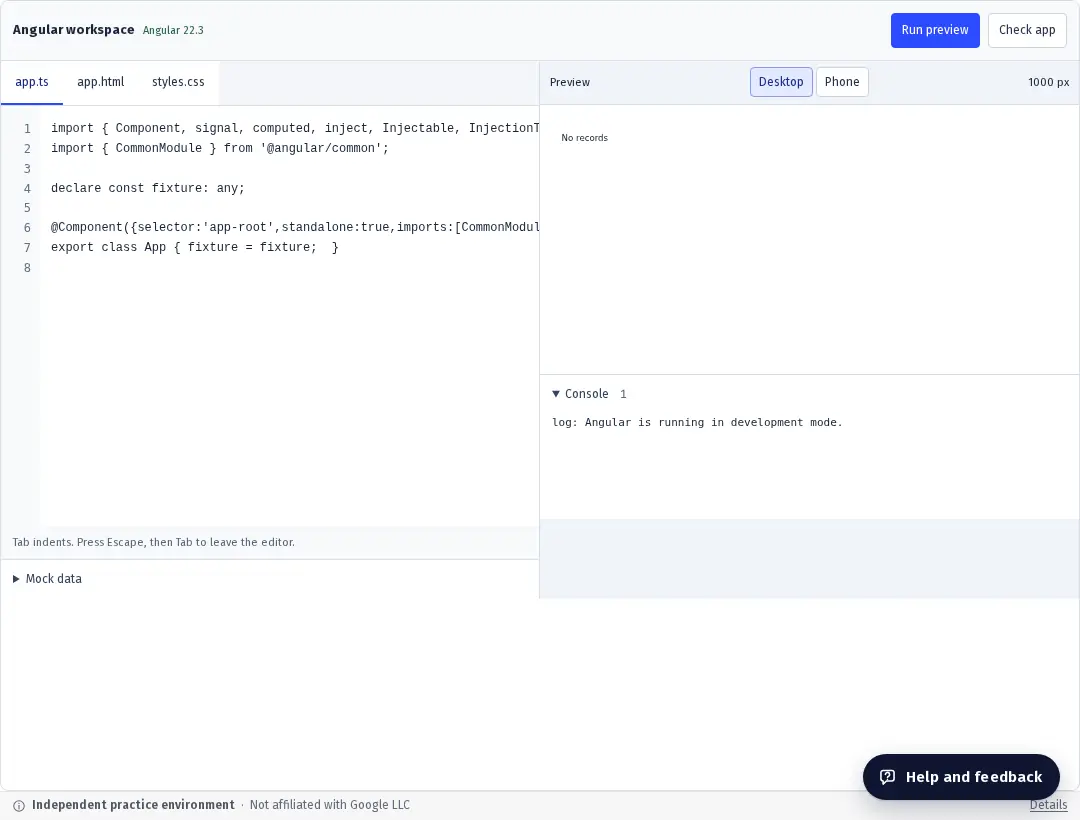
The first unit, Components and templates, is free and needs no account: 4 lessons and 23 checked exercises. The whole course is in the One Course plan, $17.99 a month at the full US dollar price, and in All Access. Many countries pay less.
Only a browser. Every exercise runs on The Work Gym and is checked as you finish it, so there is nothing to install or set up.
Yes. It runs in the browser on a Mac, in Safari or Chrome, and on a phone, where the practice area fits the screen. There is nothing to install on either.
52 lessons and 323 checked exercises, about 1 hours of practice in all.
It prepares you for angular implementation tasks and developer interviews, and it includes 2 timed mock exams.
Unit 1, Components and templates: 4 lessons and 23 checked exercises, with no account or card.
Start the free unitThe rest of the course opens with a One Course or All Access plan. See plans and prices
Choose access here. Your course is already selected.
Full price in US dollars.
Build a dispatch board in eight carried steps, combining stable record identity, active filtering, visible counts and totals, sorting and selection.
8 stepsCase study · IntermediateRoute-order incidentInvestigate a wildcard masking the order route through six carried stages, record the diagnosis and apply a route ordering supported by navigation evidence.
6 stepsProject · AdvancedHTTP order intake projectBuild HTTP order intake with a reactive name-and-amount form, checked drafts, immutable record creation, form reset, request recovery and reconciled summaries.
8 stepsCase study · AdvancedStale-state incidentReproduce a stale signal snapshot, compare captured and computed values, then record and apply a repair that follows repeated source updates.
6 stepsProject · ExpertRouted search projectBuild a routed search workspace with RxJS cancellation, reactive detail parameters, failure recovery and lifecycle cleanup while keeping the newest results visible.
8 stepsCase study · ExpertFiltered-report incidentInvestigate a filtered report whose total includes hidden rows, record the intended total basis and apply a repair that follows the visible list.
6 stepsMock exam · ExpertAngular developer job testComplete eight original Angular developer tasks in 35 minutes, covering component contracts, dependency injection, routing, forms, HTTP, request switching and component tests.
8 questions · 35 minMock exam · ExpertAngular maintenance job testComplete eight original maintenance tasks in 35 minutes, checking state boundaries, validation, HTTP failures, cleanup, cache invalidation, accessibility and record filtering.
8 questions · 35 minWrite Angular components and templates in a file editor and run the application in the preview.
Start with interpolation, event bindings, signals and control flow. Continue through component inputs and outputs, services, routing, forms, HTTP and RxJS. The workspace uses the real Angular compiler and a TypeScript checker. Checks inspect rendered results after interactions and repeat them with hidden records. Three growing projects cover a dispatch board, HTTP order intake and a routed search workspace. Investigate faults, practice developer interviews and complete two original timed job tests. HTTP responses are local fixtures, so the exercises don't connect to external accounts or production services.
Beginner
Practice Components and templates in a running Angular app.
Practice Signals and control flow in a running Angular app.
Practice Component contracts in a running Angular app.
Intermediate
Practice Services and providers in a running Angular app.
Practice Forms and validation in a running Angular app.
Advanced
Practice HTTP and observables in a running Angular app.
Practice Stream coordination in a running Angular app.
Practice Lifecycle and regression tests in a running Angular app.
Expert
Practice Reusable view behavior in a running Angular app.
Practice Application delivery in a running Angular app.
Practice Developer assessments in a running Angular app.
Start with the component class and its template. Then make the page react to a click, derive a total with computed, and show a collection with @for. Empty data and a valid zero need different treatment. The later work adds component communication, shared state, navigation and forms before asynchronous requests and tests.
The course has four levels. Practice sets ask you to use a unit’s skills on new data; projects and case studies combine them. Interview sets and timed mock exams give you less guidance.
Use the Angular practice exercises for task briefs and failure cases, or the Angular interview questions to rehearse the explanation behind your code. The official Angular documentation is the reference for framework behavior.
This is a focused practice workspace. Local CLI configuration, production deployment and a complete application repository need work outside it.
Compare templates, state and application structure in Angular versus React, then review Angular signals with a computed total.
The practice workspace runs in the browser. For a local project, use the installation steps in the official Angular documentation.
No. It teaches modern Angular with components, signals and TypeScript. AngularJS is the older 1.x framework.
Basic HTML, CSS and JavaScript. The JavaScript and TypeScript course covers the language, and Front end covers web pages and React.
The first unit is free without an account. Pricing explains the plans for the rest of the course.